Two More Reasons to Get Your Inspirational Quotes from Reputable Sources

This post concerns an inspirational quote that is often misattributed to Harriet Beecher Stowe and Joan Baez.  Read on to learn who really wrote it.

The Misattributed Quote and Its Variations

“All serious daring starts from within.”
Harriet Beecher Stowe

“All serious daring starts from within.”
Joan Baez

The Correct Quote

“All serious daring starts from within.”
Eudora Welty
One Writer’s Beginnings, chapter III

Here is the quote found in Welty’s One Writer’s Beginnings:
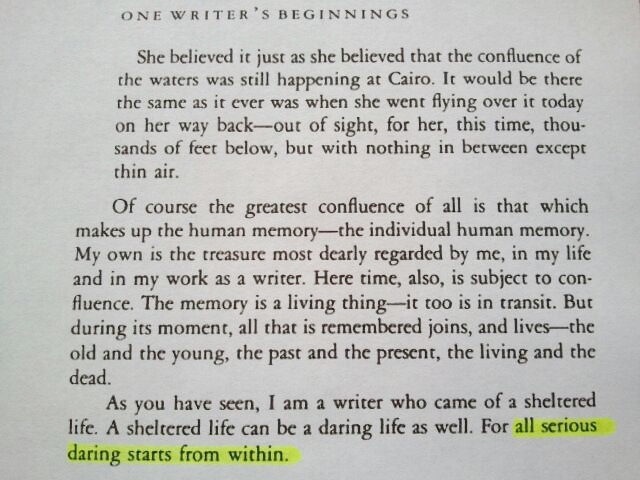
The quote found in chapter III of One Writer’s Beginnings by Eudora Welty

The quote found in chapter III of One Writer’s Beginnings by Eudora Welty

The Sources of the Misattribution

For this misquote, it looks like the quote virus has spread its ugly tendrils to the outer reaches of the universe.  Not only is it found misattributed to Harriet Beecher Stowe but Joan Baez gets credit as well.  Of the 124 websites I looked at featuring this misquote, 66 are websites or web pages strictly dedicated to quotes.  Stowe is the more popular misattribution with 47 occurrences, and Baez receives the remaining 19.  The 58 non-quote websites consist of mostly blogs followed by businesses, women’s topics, education, and quotes paraphernalia for purchase.  There were seven more pages I did not look at as my eyes were bleeding after perusing 124 sites.  So my statistics are less than what is actually out there in cyberspace.  Additionally, I discovered three books of quotes also misattributing the quote to Stowe and Baez; there are most likely others.

Based on the above numbers, quote websites and blogs are the main source of infection for this misquote.  Be very wary when obtaining quotes from these sources.  As I’ve discussed in previous posts, in the age of the internet, all it takes is one website or one book with an erroneous attribution to start a pandemic spreading the misquote far and wide.  This phenomenon occurs because most quote websites derive quotes from other quote websites and quote books and then bloggers get their quotes from these websites and books and so on and so forth.  The result is that people like Eudora Welty don’t get full credit for their amazing words and thoughts.

Give Credit Where Credit is Due

I must confess that before today I was not familiar with Eudora Welty (1909–2001), the true originator of today’s quote.  She was an American author who won the Pulitzer Prize for her novel The Optimist’s Daughter.  She also received recognition for her literary contributions through various awards and honors, including the Presidential Medal of Freedom in 1980.  This quote is from her memoir One Writer’s Beginnings.  It is a shame that it is being attributed to other people as she was obviously a remarkable woman whose words should be honored and given proper credit.

Help Kill the Quote Virus

I encourage you to visit my “What You Can Do” page for tips on how to avoid being duped by fake quotes.  And please be sure to share the knowledge.  Once again, I will conclude with my motto:

“Investigate.  Don’t propagate.  Demand integrity in quoting.”

©Sue Brewton

F. Scott Fitzgerald Gets Credit Where Credit Isn’t Due

Today’s post concerns a quote that is widely misattributed to F. Scott Fitzgerald.  It appears most commonly on the internet as well as in a few modern books.

The Misattributed Quote

“Our lives are defined by opportunities, even the ones we miss.”
F. Scott Fitzgerald

The Correct Quote

“Our lives are defined by opportunities, even the ones we miss.”
Eric Roth
The Curious Case of Benjamin Button screenplay
Dir. David Fincher
Paramount Pictures, 2008.

The Cause of the Misattribution

The correct author of this quote is the screenwriter, Eric Roth, who wrote the screenplay for the 2008 film The Curious Case of Benjamin Button which is based on the short story of the same name written by F. Scott Fitzgerald.  Obviously the confusion stems from two different works, a screenplay and a short story, having the same title.  It should be noted that even though a screenplay is based on a book or a short story, that does not mean it will contain the same narration or dialogue.  In this case, the quote appears in the screenplay only which means Eric Roth is the correct source.

The Sources of the Misattribution

After analyzing 88 websites featuring this misquote, I found that 37% are quote websites, and 35% are blogs.  The remaining 28% are either book websites or social media sites.

Note that quote websites make up the largest percentage.  This demonstrates that you should never trust a quote from a quote website.  Although it would seem that a site specializing in such a narrow subject matter would be a reliable resource, in reality it is not.  The quotes featured on these websites are not verified quotes.

Blogs are the second highest percentage, so it goes without saying that they are also not a good resource for quotes.

For Sale

Much like the misquotes in my previous posts, today’s misquote is available for purchase.  It can be found on a site selling wall art, and depending on the size of the decal, the price range is $31.95 to $49.95.  I would say that’s a pretty decent profit for flawed merchandise.

Most Disappointing Find

The most disappointing thing about this misquote is that it appears on websites that celebrate books.  Some of them are strictly dedicated to quotes from books, and some of them feature reviews and discussion about books.  What I find interesting is that readers have posted today’s misquote as their “favorite” quote from F. Scott Fitzgerald’s The Curious Case of Benjamin Button which they supposedly just finished reading and are now reviewing and commenting on.  I’ve seen posts of this nature on several different websites.  For example, one reader lists ten of her “favorite quotes from some amazing books,” and her second one is today’s misquote complete with a photo of the book.  This person is the primary book reviewer on this website, and clearly she did not really read Fitzgerald’s short story.  One has to wonder how many people are “faking it” on these bibliophile sites.  Being a book lover myself, I’m actually very disheartened by this discovery.

Kill the Quote Virus

In conclusion, what I call the “quote virus” is continuing to spread its germs across the internet.  To learn how you can avoid getting duped and infected by the virus, go to my “What You Can Do” page for a list of pitfalls to avoid.  Please be sure to share the knowledge.  I will close once again with my nerdy little mantra:

Investigate.  Don’t propagate.  Demand integrity in quoting.”

©Sue Brewton

No, Louisa May Alcott did not write that.

The topic of today’s post is a motivational quote that is not only falsely attributed to Louisa May Alcott but is sometimes taken out of context.  It is very popular on quote websites as well as social media.  My findings are as follows.

The Misattributed Quote

“He who believes is strong, he who doubts is weak.  Strong convictions precede great actions.”
Louisa May Alcott

The Correct Quote

“He who believes is strong, he who doubts is weak.  Strong convictions precede great actions.”
James Freeman Clarke
Common-Sense in Religion: A Series of Essays, chapter XV

The Correct Source

The correct author of this quote is James Freeman Clarke (1810–1888), an American theologian.  His book Common-Sense in Religion: A Series of Essays (James R. Osgood and Company, 1874) features this quote in chapter XV.  Here is the excerpt:

The Correct Quote Found in Chapter XV of Common-Sense in Religion by James Freeman Clarke

The Quote Found in Chapter XV of Common-Sense in Religion by James Freeman Clarke

The Sources of the Misattribution

To see how widespread this misquote is, I did a search on Google, and it returned ten pages worth of websites incorrectly attributing this quote to Louisa May Alcott.  The irony is that the vast majority of them are quote websites or websites presenting quotes as a major feature.  The remaining sites featuring the misquote are mostly blogs and social media.  It even rears its ugly head in an article written by a university professor.  Obviously, these are not good sources for verified quotes.  Never trust a source that does not include details about the quote such as the work in which it is found accompanied by corresponding information such as chapter, act, scene, stanza, line, etc.

For Sale

This particular misquote also appears on a website that is dedicated to creating customized quote paraphernalia such as coffee mugs, posters, awards, etc.  The site provides the quote, and the customer chooses the product on which the quote is to appear.  Although the quote can be edited by the customer, I would imagine most people would assume the information is correct and leave it as is.  One has to wonder how much money is being made on these flawed products.

Out of Context

Finally, I noticed that this misquote oddly appears on several anti-bullying websites.  One of them actually includes it under the category “Famous Bullying Quotes.”  This quote is in fact not about bullying at all.  As mentioned earlier, it is from a book written by the theologian James Freeman Clarke titled Common-Sense in Religion: A Series of Essays in a chapter titled “Common-Sense View of Salvation by Faith.”  Clearly the subject matter is not bullying.  Although the words can be interpreted with an anti-bullying sentiment, to assert they are specifically about bullying is taking the quote out of context.  This is a prime example of how a “quote virus” propagates (yes, I made up that term).  All it took to spread this infection was one person posting this misquote on one anti-bullying website, and from there it multiplied to other anti-bullying websites.  The end result is that there is now a growing number of people in the world who not only believe this is a quote by Louisa May Alcott but also believe it is a famous bullying quote.  And this group of poor, lost souls swirling around in the misquote eddy of despair will only continue to grow.

Final Diagnosis

The final diagnosis is that this quote is showing symptoms of misattribution and erroneous context because it has been infected by the quote virus.  Without intervention, it will continue to spread.  Quick!  Somebody call a doctor!  We need the vaccine!  Oh yeah . . . there is no vaccine.  Well, I guess the next best thing is to educate.  You can help stop this infection from spreading by sharing the knowledge.  Share this post with friends and family, and follow my tips on the “What You Can Do” page.  And remember to

“Investigate.  Don’t Propagate.  Demand integrity in quoting.”

©Sue Brewton